Washi
Since its introduction to Japan, handmade papermaking has been at the center of Japanese life, both religious and secular. Paper plays an important role in many rituals, ceremonies, and festivals during special occasions, as well as in countless ordinary everyday activities. Handmade Japanese paper, washi, is a perfect example of the four principles of Japanese aesthetics: purity, tranquility, harmony, and respect. Papermaking was introduced to Japan in the sixth century, and paper's use expanded steadily in the following centuries. In contemporary times, this ancient craft is kept alive by papermaking families and papermaking villages in different parts of the country. |


Noh or Nogaku
Derived from the Japanese word for "skill" or "talent," Noh is a major form of classical Japanese musical drama that has been performed since the 14th century. Many characters are masked, with men playing male and female roles. Traditionally, a Noh performance can last all day and consists of five Noh plays interspersed with shorter, humorous pieces called kyogen. However, present-day Noh performances consist of two Noh plays with one kyogen play in between. The field of Noh performance is extremely codified and regulated by several groups, who have been performing for more than 16 generations. |
Shomyo
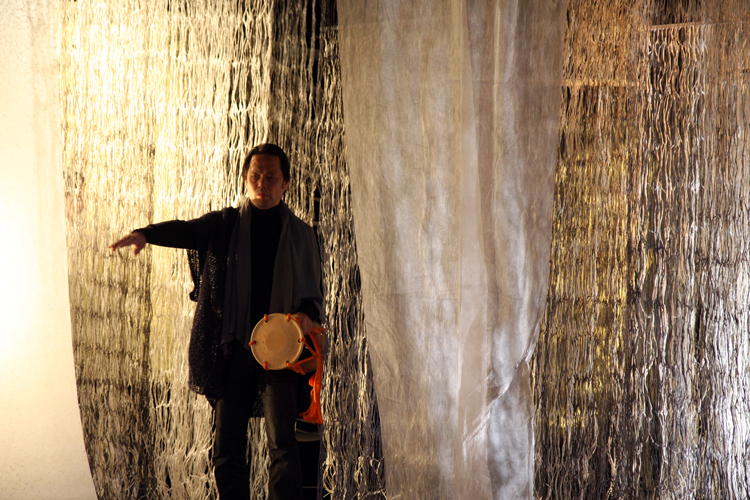
Shomyo is a kind of chanting of Buddhist scriptures that adds melodic patterns to sacred Buddhist words. It originated in India, the birthplace of Buddhism, and then went to China. In China, the Buddhist scriptures were translated into Chinese and new texts were written as well, and the forms of singing were arranged and adapted. In the fifth and sixth centuries, this tradition was transmitted to Japan along with Buddhism and was called Shomyo. This oldest form of Shomyo played an important part in the ceremonies for the dedication of the great Buddha at Todaiji Temple in Nara in 752. |
Shirabyoshi
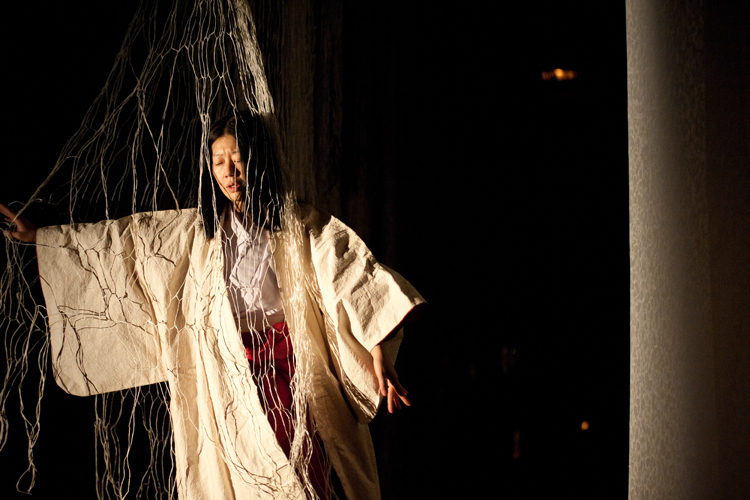
Shirabyoshi were female dancers, prominent in the Japanese imperial Court, who performed traditional Japanese dances. They would perform for nobles and high-ranking samurai and at celebrations. Shirabyoshi emerged in the late Hein period (10th-12th centuries). It was a time of cultural change, so to survive, some women turned to performing. A shirabyoshi was a woman who dressed in men's attire and performed dances for the gods. The name shirabyoshi means "white rhythm" and comes partly from their make-up and partly from their slow and rhythmic songs. They were required to be educated, including being able to both read and write, and were talented poets, musicians, singers, and dancers. It has been said that the shirabyoshi culture greatly influenced Noh drama by bringing forth kusemai, an unorthodox form of dancing, and introducing it to Noh. |

Biwa
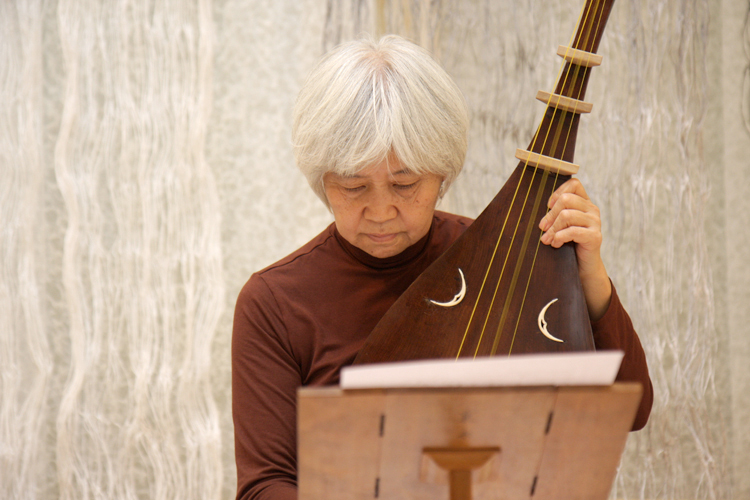
The biwa is a Japanese lute often used in narrative storytelling. The biwa is the chosen instrument of Benten, goddess of music, eloquence, poetry, and education in Japanese Shinto. Within Japan are variants of the biwa and its performance, and a very popular form was the hoshi biwa of blind wandering musicians called lute priests up until the mid-19th century. Different genres of biwa playing have been preserved by passing down the instrument and its teachings through families from generation to generation. The oldest styles are perhaps gaku biwa and moso-biwa (blind priests' biwa): the former is related to gagaku (an ensemble functioning mainly in the palace), introduced in the seventh century; the latter, also called kojin-biwa (for the god of the kitchen), is a religious chant originating in Kyoto in the eighth century. Since the latter half of the 16th century, biwa uta (biwa singing), has gradually become the most representative form of biwa music. |
|